Cardiovascular Disease in Younger Women: Michelle’s Story

February is American Heart Month. Cardiovascular disease is the leading cause of death in the United States, and heart attack and stroke are responsible for one in three deaths, or 2,200 deaths per day, according to the CDC. Heart attack and stroke are all too familiar in my family. But this fall, stroke touched another important person in my life, my dear friend Michelle. She is a lifelong competitive athlete, and as an extremely physically fit, health-conscious young woman who was already an advocate for awareness of heart disease, she is the absolute antithesis of what you would think of as a cardiovascular patient.

And that’s the point. At thirty-two and in wonderful health, she had a stroke.

As her friend and former roommate, I have always admired Michelle’s tenacity and drive—from running marathons and competitive cycling to building her career and maintaining friendships, she does everything with gusto. She has responded to having a stroke with grace and that same tenacity, and I am so proud of her continued efforts to advocate and raise awareness about cardiovascular disease in women. Please read her story below, in her own words, and learn the signs and symptoms of stroke and heart attack.

*     *     *

MichellebikeI’d like to say a special thank you to Laurie for inviting me to take part in her wonderful blog. I believe the work she is doing is so meaningful for everyone. We will all experience illness at some point in our lives. Many of us may just get the flu but often we all struggle silently with illness like pain or diabetes. I appreciate the opportunity to share my story.

I was always the “healthy” one. I’d been an athlete for as long as I could remember. I teased my family that I was going to be an athlete because they used to take me cross country skiing in the Sierra Nevada Mountains in California for hours during the winter as fun. High altitude training at the age of 7!

As a junior national athlete in rowing, I went on to row in college and later picked up running marathons for 8 years. In 2010 I found my way to competitive bike racing via triathlon. The training and female competitive spirit in bike racing appealed to me. Yet, I wondered if we could do something more then just ride bicycles. What if we could give back to the community for a cause while training and racing?

The cause for my race team, RED Racing, was inspired by the death of my father, who passed away from a heart attack in 2006. It turned out that many women on my team had their own families impacted by heart disease and stroke. While my cause was around heart health and my dad, I soon learned that heart disease and stroke is the #1 killer of women in the U.S. Today, RED Racing is a group of female cyclists committed to developing competitive racers while building awareness and supporting the American Heart Association.

Ironically, on Oct 13, 2012 I found out that this disease can affect anyone, including me.

I was riding my bike that Saturday morning with a friend. We were about 35 miles out and headed home when my vision suddenly changed. I got off my bike ASAP and thought maybe I needed to eat something so I wolfed down my shot blocks but things didn’t change. The world looked sideways. I discovered that by shutting one eye everything was fine. Closing the other eye again, everything was fine. But with both eyes open I had double vision.

I was definitely worried and couldn’t imagine what was happening. I thought, “I’ll just close my eyes and take a deep breath and this will all go away. I can handle this. I can control this.”

My friend helped me walk to a driveway to sit down and call for help. While seated I kept falling towards the right and wasn’t able to see clearly. A woman (a mom) pulled out of her driveway and stopped to check on us asking if we were okay. For the first time in my life, I actually said “no,” and asked her to  drive us to urgent care. She ended up driving us all the way back to Baltimore and to Johns Hopkins. She and my friend are my guardian angels! They really saved me that Saturday by knowing to call for help and getting me to the hospital as fast as possible.

I couldn’t make my eyesight go back to normal and in the car to the hospital things got a little worse. My speech was slurred and I threw up (although that made me feel better.) By the time we go to the hospital about an hour had passed. I had a team of 10-12 people assessing me and got to a CAT scan very fast, where the brain scans showed that I had a tiny stoke but no major damage. All tests show that I’m perfectly healthy and they don’t know why this happened. The one thing to point to is birth control.

Honestly, I’m still a little anxious by all of it. I really never thought this could happen to me. Even when I was having symptoms I didn’t think it was a stroke. I thought maybe I was tired or didn’t eat enough. This was a terrifying experience. I’m so lucky to see. I’m so lucky to be able to get back on my bike. I’m so lucky to be alive.

I’m grateful! So grateful.

Now, about 3 months later, I feel great. My vision is fine but I’m still going through some blood tests as the doctors are trying to understand why this happened. I’m off birth control and take a small 81mg aspirin daily. Now, I have a chronic illness. I have an acute understanding about how fragile life is and how quickly things can change. I’m not the only 32-year-old who has had a stroke and many of the stories I’ve heard are devastating. Paralysis, blindness, and death could have been my reality. Now I consider everything I eat. I worry about what pregnancy could bring and I live my life with an illness that is silent. Another stroke could be in my future and there aren’t many warning signs for me to show if I’m at risk. The best thing I can do is to eat leafy greens and live the best life I can.

RED Racing
big heartWe are a group of female cyclists committed to developing competitive racers while building awareness and supporting the American Heart Association. Our combined mission will be to dispel the myths and raise awareness of heart disease as the number one killer of women. We hope bike riding can be another means to empower women to take charge of their heart health, to feel young again, and to be inspired to live a healthy lifestyle. RED Racing is the avenue for us to raise awareness and support the AHA in its fundraising and awareness goals. (Editor’s note: you can check out the RED Racing fundraising page by clicking here.)

*     *     *
Thank you for sharing your story, Michelle. I am so grateful you are doing so well.

The Last Best Cure and the Future of Chronic Illness

Chronic illness is one of the greatest public health issues of our time. I wrote In the Kingdom of the Sick in part to explore attitudes towards illness, and the influence of science, technology, and culture on the experience of being a patient. To have a meaningful conversation about the future of chronic illness in this country, we need to understand the complex variables that go into our perceptions of illness and wellness.

DJN coverWhat might that future look like? In her new book, The Last Best Cure, award-winning health journalist Donna Jackson Nakazawa brings us on her quest to find out how to awaken the healing potential of her own brain, with the hope of bringing about lasting change.

As a huge fan of her previous book, The Autoimmune Epidemic, and as someone who is very much aware of the state of chronic illness in this country, I asked Nakazawa why this particular book is so important at this juncture. Her response is below:

*    *    *

One of the reasons that I set out to research and write The Last Best Cure is that the numbers of Americans with chronic conditions has been escalating so fast it’s frightening. Today in the United States, 133 million Americans – one out of two adults — suffer from at least one chronic condition. These include back pain, irritable bowel and digestive disorders, arthritic conditions, migraines, thyroid disease, autoimmune diseases, depression and mood disorders, cancer, Lyme disease, fibromyalgia, chronic fatigue syndrome and chronic pain. Experts predict that these numbers, which have been rising steadily by more than one percent a year, will rise 37% by 2030.

And most of us are women. We’re more likely than men to suffer from migraines and lower pack pain, twice as likely to suffer from depression, irritable bowel disease and arthritis. And women are three times more likely than men to suffer from autoimmune diseases including lupus, multiple sclerosis, type 1 diabetes, thyroiditis, rheumatoid arthritis and inflammatory bowel disorders. Ninety percent of fibromyalgia sufferers are women. And women are more likely to suffer from a compilation of chronic conditions than are men. Lupus and migraines. Back pain and fibromyalgia and irritable bowel.

We may tell ourselves that Americans are getting sicker simply because we’re living so much longer. But a new study tells us that’s not the case. Americans of all ages up to the age of 75 live shorter lives and experience more chronic illness during their lives than in other countries. In fact, a recent study — a 378-page report convened by the National Research Council, an arm of the National Academy of Sciences — shows that not only do Americans have a lower life expectancy and higher infant mortality than most high-income countries, we are less healthy throughout our lives than citizens of 16 other wealthy nations.

And every year Americans are becoming less healthy than our counterparts in peer nations around the globe. The U.S. is experiencing a large and widening “mortality gap” among adults over 50 compared with other high-income nations. “What struck us — and it was quite sobering — was the recurring trend in which the U.S. seems to be slipping behind other high-income countries,” says lead author of the report, Dr. Steven Woolf.

We might think that this is due to gun violence, or poverty. But that’s not the case. Even Americans who possess good health insurance, are college-educated and are in upper-income brackets are in worse health than their counterparts around the world — a finding that no one quite comprehends. Woolf puts it this way, “People with seemingly everything going for them still live shorter lives and have higher disease rates than people in other countries.”

I wrote The Last Best Cure for every person who suffers from chronic conditions. We’re chronically ill and we’re getting more chronically ill as a country every minute. I wrote a great deal about why I think that’s the case in my last book, The Autoimmune Epidemic.

The Last Best Cure: My Quest to Activate the Healing Areas of My Brain and Get Back My Body, My Joy and My Life is the natural progression after The Autoimmune Epidemic. It’s about participating in a reversal trend, to reclaim good and healthy lives. As a country, as people, as individuals. Isn’t it time?

*    *    *

Indeed it is time. The Last Best Cure will be out in just a few weeks, and you can check out more of Donna Jackson Nakazawa’s writing on her blog. Be sure to “like” her FB fan page for book updates and events.

Update on #KidneyforMike

We want to share a quick update regarding our search for a living donor kidney match for my father.

First, we want to take a moment to extend our heartfelt gratitude for the tremendous outpouring of support, concern, and generosity extended to us, from sharing our urgent request on social media platforms to sending e-mails of encouragement and much, much more.

We have been taken aback by the willingness of so many people to consider donating a kidney, and by the absolutely amazing response our request generated. Feeling so much support has been an unexpected blessing in all of this. Truly, it is overwhelming. I know my father is incredibly emotional about it and humbled by it—we all are.

While we have not solidified a donor, we remain cautiously hopeful and optimistic we will find one soon, and we are extremely fortunate to have so many people willing to consider doing this. His condition has deteriorated more rapidly than we anticipated so in the interim, he will start peritoneal dialysis as a bridge to transplant.

This whole process takes a long time and inevitably includes setbacks and challenges. We will continue to update you as we can, and we ask for your continued good thoughts and prayers.

Updates, Part 2

Remember that post where I asked you to subscribe using either the feed button at the top right or the box on the right sidebar, where you can enter your e-mail address to receive updates that way?

I did not realize that said box had disappeared into the virtual ether. I contacted The Person Who Knows Much More About Wonky Coding Problems and Disabling Features Than I Do, and everything is fixed now.

#Technologyfail.

So, if you could take a moment and sign up with either of those options, I would really appreciate it.

Thanks, and apologies for any confusion!

New Year’s Updates

After yesterday’s reflections on 2013, I thought it was time for some more pragmatic updates and housekeeping.

I posted this on Facebook but should mention here that IN THE KINGDOM OF THE SICK received a starred review in the December issue of Booklist. It’s an exciting way to start off pre-pub activities.

Want to stay updated on book news and reviews, author events, and related publicity? Make sure you subscribe to this blog using the feed button up top (next to the social media buttons) or enter your e-mail on the right sidebar to receive posts that way. Also, if you’re on Facebook, consider “liking” my Facebook Author Page, where I will post relevant links and updates.

As always, you can find me on Twitter, too.

In addition to book stuff, I have a lot planned for 2013 on this blog, including fresh content, interviews, guest posts, and more, so be sure to stay connected.

On 2013 (Or, Side by Side)

It was helpful to re-read my New Year’s post and its emphasis on being more present as I thought about how to approach this first post of 2013. Being present, being mindful, really, involves focusing on the actions and emotions of the moment.

Grief. Joy. Sadness. Happiness. Side by side.

A couple of years ago, once we were through initial trauma of my mother’s brain injury and could focus a bit more on issues of rehabilitation, the losses stretched out in ripples, and the fear and sadness also mixed with gratitude and anger. After so many years of struggle we were finally expecting a baby, and here I was, in my third trimester, on bed rest and fighting to keep that baby safe. I wanted my mother. I wanted my daughter to know her grandmother. I wanted her birth to be free from all this heartache and upheaval, not just for me or for her, but for all of us. I was angry that we wouldn’t be able to just have the joy.

But I didn’t realize then the heart and mind’s capacity for preservation and compartmentalization. I didn’t know that I could weep for mother’s situation and yet hold my daughter in my arms and feel pure, all-encompassing joy. That even when it felt like things were crashing down around us—mother in rehab, father in the hospital, maternity leave that ended early, sickness for baby, sickness for me, plus all the normal newborn, breastfeeding, sleep deprivation woes—I could feel so utterly content, that even as my hold on all the other moving parts of my life slipped through my fingers, I never felt more solid, stable, or sure.

Over the past two years, I’ve often thought about this dichotomy: How I’ve never been happier than I am when I am with my daughter, how this always-cheerful, adaptable, chatty, precocious little girl has changed us, changed everything. How I gain so much every day I get to be her mother, even as more and more slips away. How I’ve re-calibrated to an ever-shifting sense of normal, where I watch people I love suffer, where we all shed more tears than we used to. Guilt lingered—did the many tears I’ve shed somehow take away from my gratitude for her? Did the joy and the love somehow mean I didn’t appreciate the gravity of all the stresses around us? Could I feel both so completely and simultaneously and have each one be true, be real?

Yes. If there is anything I have absorbed from the past few years, it’s that.

I remember so clearly the day this fall we found out my father’s lone remaining kidney was indeed failing. I called my husband but couldn’t get all the words out to tell him, there simply wasn’t enough air. Heart-ache, I repeated the word in my head as I battled my way down busy Huntington Ave, the traffic lights blurry through hot tears. This is what it feels like when your heart aches.

I picked my daughter up from school later that same day and listened to her chatter away about her day and who and what she played with. We went to the library, where we played with trains and picked out books. She held my hand in the parking lot, and helped me empty the dishwasher. In the moment, in the middle of our normal activity, I found the air I needed. I laughed. Again and again the pieces threaded back together.

Watching my father deteriorate these past few months has been a series of chest-clenched moments, where I know what I see but don’t want to see it, where I can’t talk about it so most times, I don’t. I’ve been conscious of creating time where my parents can be with my daughter. No matter how terrible he feels, when he is with his grandchildren, when they run to him with their arms outstretched, when my daughter climbs onto his lap and says, “I love you so much,” nothing else exists for him but that moment.

Waiting for his transplant and watching him get worse and worse while at the same time, having so much hope and optimism that he will have a good outcome…again, we have grief and joy, sadness and hope, all mixed up.

I won’t say that the heart-bursting gratitude we have for our daughter, for this life we’re living with her, is sweeter or more appreciated because of all the difficult stuff that exists right along with it, because I can’t imagine feeling any less than this, regardless of what else might be going on. No one ever gets just the joy, that’s not how life works. But if we’re lucky, even with the sadness, we still get joy. We can feel both so completely and simultaneously and have each one be true, be real. Side by side, each a measure of love.

So that’s my hope for 2013. I don’t know how much of the tough stuff the year will bring, but I want to be mindful and fully present in the joy wherever we can find it, to not let it slip by without squeezing every ounce out of it.

On the Helpers

At some point every day, often right after I’ve dropped her off at school and am already missing the steady stream of chatter and questions, I say a short, simple prayer:

Thank you for her. Keep her safe.

I said it Friday as I drove away from my daughter’s school, before, and I said it today after I kissed her goodbye.

I can’t keep her behind closed doors, under my own eyes every second, nor would I want to. I want her to feel confident in her independence, to explore the world, to feel secure in her place in this world. I can’t shield her completely from the bad, the hard, the painful—none of us can. But we can help them remember all the good, and how to look for the good, and how to be a part of the good.

I don’t want this to become political, nor do I want to co-opt the grief from the many victims of Friday’s shooting. So much has already been written and said. Like so many, I shed a lot of tears over the weekend. So many tears were for the innocent, and those they left behind, and many were for the stories of bravery, sacrifice, and love the teachers, staff, and responders all showed.

Many of you have likely seen the FB post about Mister Rogers, and how his mother told him to look for the helpers in the midst of horrible things.

I want my daughter to know there are helpers, and I am incredibly grateful for the caring, compassionate educators who allow her to feel secure and loved everyday.

Church was unusually packed this weekend. I imagine drop-offs were more poignant and protracted at schools all over this morning.

Thank you for them. Keep them safe.

On Traditions

Since my daughter was born, we’ve given even more thought to the kinds of rituals and traditions we want to bring into our lives. Some, like the huge Italian Christmas Eve dinner, the new Christmas ornament that tells a story about the past year, the Advent wreath and calendar, and celebrating a second Christmas with dear relatives who live further away, are traditions from both sides of her family that we are all keeping alive. Some we’ve established more recently: we decorate our tree and have grandparents over to join us; we go to morning Mass on Christmas Day and have brunch, just the three of us; we bake cookies for Santa and read The Grinch Who Stole Christmas on December 23rd.

(As an aside, what are your favorite gluten-free Christmas cookies, with bonus points for simple recipes and prep times? We want something that can stand the test of time and be a regular staple of Christmas Eve….)

Some, we’re weaving in this year, and hope to make them permanent traditions. A friend of ours has her children receive three gifts Christmas morning, to honor the gifts the Wise Men brought baby Jesus, and to focus on reverence and love on Christmas, not an avalanche of presents, and we love this idea. (Getting three gifts can be categorical, too—for example, if my daughter asked for books, she would get more than one, but books would be one of the three gifts.)

We check out new Christmas-themed books from the library each week of Advent, some that are appropriately religious for a two-year-old, and some that are a bit more secular, too. (She asked me the other day what God loves and why, so the wheels are turning.) We’re going to dinner as a family on December 23rd , before we come home and make cookies, just to stop and spend time as our little family unit before all the festivities begin, and hopefully that will be a regular thing, too, especially as she gets older and life gets even more busy and complicated.

Without being totally conscious of it, we’ve been moving toward an ongoing celebration of Christmas and family, rather than just the day itself. There is so much going on right now as we wait for my father’s possible transplant that for all of us, simplicity and quality time are more important than ever. It is an emotional process, watching my father’s physical decline every day, while balancing the sadness and fear with hope and optimism that he will get a transplant and have a successful outcome. The food will be delicious and the kids will all love their presents, but really, it doesn’t matter what we end up eating, wearing, or unwrapping. I just want a few minutes of joy—for my father, for all of us.

What are your hopes for this holiday season? What traditions are your favorites? Are you doing anything new or different this year?

Solace in the Good

I fully intended to post this right on or near Thanksgiving…

And somehow, the mound of grading and the professional development projects and prep work to host Thanksgiving besieged me. I spent the day of Thanksgiving itself enjoying time with family and dear friends, and being present in the moment seemed like the best way to express thankfulness for all the good that surrounds me.

But this is what I wanted to say then, and this is what I think about so often lately. The response to our search for a living donor kidney match for my father has been tremendous. Knowing there are so many people out there willing to be tested and consider making this huge sacrifice has made for an emotional few weeks. “Overwhelmed” is a word that gets overused, I think, and often has negative connotations, but truly, I am overwhelmed with gratitude, and with the goodness that is out there.

I am grateful every day that I get to wake up in a world where there is an earnest little toddler who wraps her arms around me and says “I love you,” and I am fortunate enough to get to be her mother. But I am grateful this is the world she wakes up to as well—one where one person’s struggle is taken up by others, where those we care about are cared about by others.

We’ve a long road yet, but we’re moving in the right direction.

Someday soon I hope to have more information to update, but for now, we take solace in the good.

CaringBridge and National Family Caregivers Month: An Interview

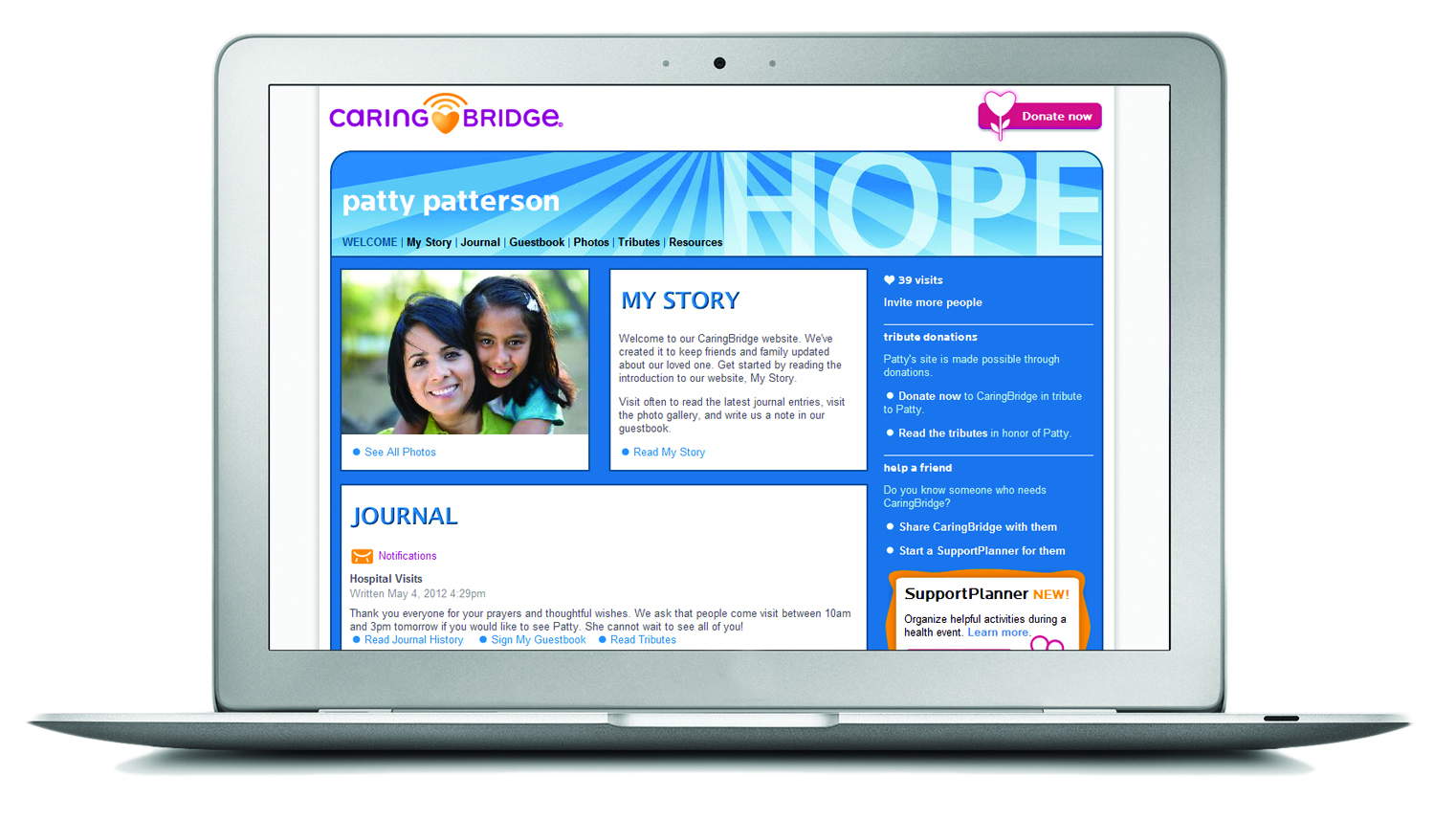
As you know from my previous post on family caregiving, it is National Family Caregivers Month, and CaringBridge is helping to spread awareness of the needs of patients and families. I had the chance to ask CaringBridge CEO Sona Mehring a few questions about how CaringBridge supports families in medical crises, and what they are doing this month.

Q. Medical and progress updates are so important, but the simple act of telling one’s story can also be incredibly therapeutic. What makes CaringBridge a unique online space for patients to share their stories?

CaringBridge is truly a “caring social network.” It is free to use. CaringBridge does
not accept advertising and does not sell users’ information. CaringBridge is a
social network providing a social good – with a funding model that allows us to
focus squarely on the people using our service, not on generating profits.

Q. I know CaringBridge Sites that are followed by thousands of people across the
country. What makes these sites such a powerful resource for support and
mobilization?

We literally connect the hearts behind the keyboards. Having a central place to
share news and receive support makes communicating during a health journey
so much easier. Instead of sharing your story over and over, you can create a
blog and post it once for everyone to read. You also have a guestbook full of
messages of love, hope and compassion that you can visit any time of day, any
time you need a boost.

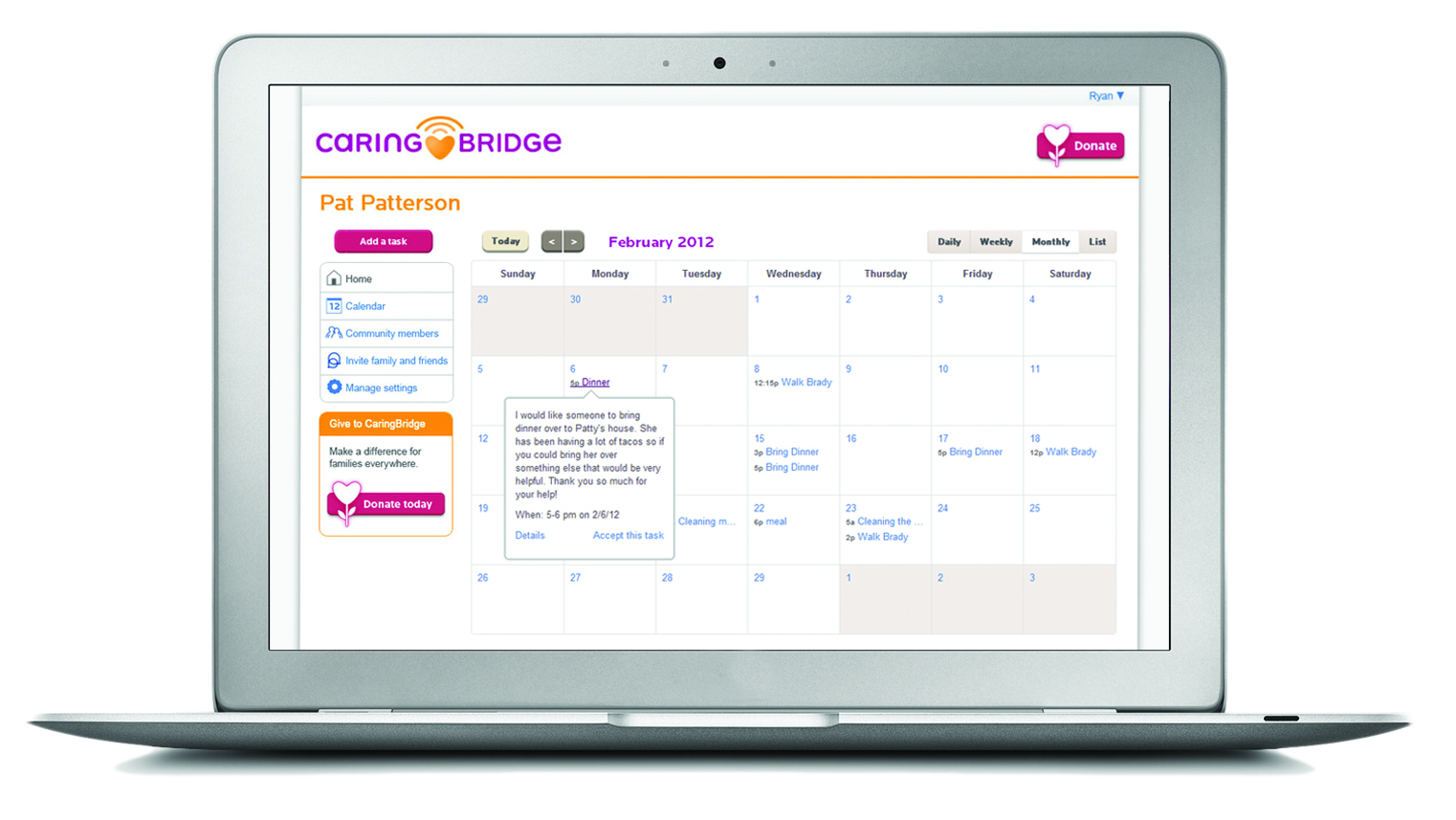
Q. How did CaringBridge SupportPlanner come about? What difference is it
making for patients and families?

This is something our users had been asking for. All of our enhancements are
based on listening to our users and our drive to provide a relevant service.
The SupportPlanner helps patients and families organize helpful tasks such as
bringing meals, rides to the doctor and pet care. When families know those
details are being taken care of, they can focus their energy on what’s really
important, like healing.

Q. I think it’s wonderful that CaringBridge Sites do not include any
advertisements, so the focus is on the patients. How does CaringBridge sustain
this model?

We are a nonprofit funded by donations. Many people who use our service feel
strongly that it needs to be available to others during a health journey so they
give back.

Q. It’s National Family Caregivers Month. How is CaringBridge celebrating those
who devote so much of their lives to caring and advocating for loved ones?

We are helping create awareness of the family caregiver and all the time, energy
and money they spend on caregiving. I also wrote a blog post asking people to share
caregiver tips and advice.

***

Thanks so much, Sona!


(Per the disclaimer in this post, CaringBridge is sponsoring this post.)