Gender and Pain in the NYT

I wrote an Op-Ed on the gender gap with chronic pain, and it was published in today’s New York Times Sunday Review. From all the patients I follow and have interviewed, I know these issues resonate with so many of your experiences, and I do hope you check it out.

For those of you interested in all of this, I delve into the gender and pain issue in greater detail in In the Kingdom of the Sick.

And speaking of news, I saved the best for last: my father is doing great after his kidney transplant, as is his donor. It is truly an amazing thing to witness, and I will write a longer post about all of this soon. Thanks so much for your support!

Facebook Twitter Email

The Night Before Transplant…

Some observations of fact:

Since 1988, there have been 116, 712 living donor kidney transplants.

Of that number, 4, 064 have taken place in Massachusetts, where we live.

Five hundred twenty-three living donor transplants have taken place at Beth Israel, where my father’s transplant will take place.

(Source: http://optn.transplant.hrsa.gov/latestData/step2.asp?)

A living donor kidney starts to produce urine in the recipient’s body before the surgery is over. (For some reason, this blows my mind.)

(Source: my father’s surgeon.)

Some observations of the heart:

No matter how many times you tell yourself all people who have this surgery are in poor health and are therefore high-risk, no matter how highly recommended the surgeons are, no matter how amazing the opportunities medicine allows for are, it is all still really scary.

Watching someone you love slip away before your eyes takes a piece of your soul. Watching that person have hope and begin to make plans for the future slowly restores it.

I can say without a hint of hyperbole or exaggeration that my father is indomitable, and has always been my hero.

Lucky for all of us, we now have another hero, whose compassion and sacrifice are giving us a second chance.

Please keep my father, his donor, our families, and both sets of medical teams in your thoughts and prayers tomorrow.

Facebook Twitter Email

In Sickness As In Health: Chronic Illness and Relationships

If you’ve read this blog for awhile, you know how important I think discussing the impact of chronic illness on relationships is. I’ve followed Barbara Kivowitz’s wise, thoughtful writing about all of this for years, and I am pleased to share that she has co-authored a new book with so many helpful insights, perspectives, and advice. In Sickness As In Health pubs today, and you can find out more about it and the challenges of navigating illness in relationships in the Q&A we did:

1.     Can you tell readers a little bit about how your own journey as a patient, a partner, and a professional led you to co-writing this book?

The short story is that my coauthor and I each lived the experience of being the ill person in our relationships and were stunned by how much the illness subverted our customary patterns of connecting with our husbands, and by how important our husbands were to our healing.  Illness became the third partner, entering into the living room, the kitchen, and the bedroom at will.  And there was nothing out there to help couples learn how to move though the illness experience together from both relational and practical perspectives.  We decided to write In Sickness As In Health so that couples could learn from each other’s stories and get practical advice from experts in different fields.

The longer story is that I, like most healthy people who enter into a committed relationship, never took the “in sickness” and “for worse” parts of the vows seriously.  They were words not predictions.  For others, not us.

However, when I was in my late forties and had been married for fifteen years, I got slammed by a mysterious chronic pain condition.  It didn’t take long to realize that while the pain resided in my body, both our lives were radically dislocated.  As partners, we had been used to being different but equal and sharing the load.  We were ordinary, and had no idea what a gift that was.  Then I went from being an active psychotherapist and outdoorswoman to a puddle of anguish and uncertainty.  My partner, a scientist and technologist had a massive problem he could not solve and devolved to being a helpless witness.  All of my empathy and intuition and all of his analytic abilities could not make the pain go away.

Suddenly, pain was the dominant partner in our relationship and our customary tools and ways of connecting were no longer adequate.  We went from being equals to being patient and caregiver, roles neither of us knew or liked.  For example:  I was used to sensing other people’s needs, not expressing my own, so when I was in the grip of a pain episode and regressed to being a crying child wanting to be held, I had to learn to figure out and boldly ask for exactly what I needed.   Richard, the arch problem solver, had to learn to just “be” with me and not keep trying to “do” for me.  Over time, we had to learn how to reorient our roles to accommodate pain and how to communicate at more honest, deeper levels more quickly because we were both too exhausted to equivocate.

I wanted to hear what it was like for other couples living with illness, so I began my blog In Sickness As In Health.  I heard so many profound stories that I realized there is a book here.  Our book combines couples’ stories, with relationship and practical advice from experts; and hopefully will help readers not only find tools they can use but also a way to feel less alone.

2.     In the book you write you learned that “under extraordinary circumstances, people can rise to the extraordinary; that illness can be a gateway and not an epilogue; and that even in the absence of a cure, healing is possible.”  That distinction between a cure and healing is so important, especially since most people with chronic illness will not receive a cure. In brief, what does that healing look like?

Anne Frank wrote in her diary, “Where there is hope there is life.”  I would humbly add that where there is hope there is healing.  And there is always something to hope for, even when a physical cure becomes unlikely.   You can hope for love and rectification of important relationships.  You can hope for greater spiritual awareness.  You can hope for comfort.  You can hope to help someone else.   You can hope to make one small corner of the world a better place.

Hope moves us towards the light; and in that light we may be able to see something that was hidden before.  And that something can be the piece we need to complete a critical part of ourselves.  I think of healing as becoming more than who we were a moment ago.  And that is always possible.

3.     You write of three dimensions of illness—the crisis, a balancing act, and regaining equilibrium. A common thread among these stages seems to be an ongoing adaptation of roles. What is your biggest piece of advice in terms of how to navigate new roles within a relationship while still maintaining one’s identity?

This is a great question and a complex one.  You could justifiably argue that we change our identities many times in the course of a relationship – parenthood, new career, death of an adult parent.  Identity flexibility in this context is a healthy adaptation and allows us to keep our balance when the tectonic plates under our relationship shift.  On the other hand, you could also say that our identity is our inner fixed point, our immutable sense of who we are, and that nothing diverts it. It serves to ground us wherever we wind up and lends us ballast.

Whichever approach to identity you prefer, one piercing piece of identity wisdom I was given when I first got sick was: “I have pain. I am not my pain.”  You have an illness, but you are not your illness.  Over time, it can become easier to lose your sense of yourself as a being that is bigger than your illness.  You may need to change roles to cope with the demands of your illness, but you do retain that essence of self that extends above the illness.  Think of roles as the cloaks you wrap around your identity to help you accommodate to shifts illness may require of you.

In my situation, I remained an intuiter and my husband remained a problem solver, but our roles quickly became that of patient and caretaker. These roles lasted for a year, and we slide back into them when I have a relapse.  My coauthor suffered a serious stroke, and her husband consciously decided not to take on the role of caretaker but rather to maintain his identity as her adult partner and have aides do the daily care.  There are many permutations, and each couple ultimately figures out its own way.

Role adaptability is how we achieve balance in our relationship, how we complement each other’s capabilities.  Illness can cause imbalance, and we then need to purposefully recalibrate our roles.

Here’s some advice for maintaining a healthy role balance:

  • Notice:   pay attention to the cues (in both partners) that tell you things are off track – illness symptoms, stress symptoms, energy levels, irritability, distance, things not getting done
  • Talk and Listen without problem solving:  pick a time when you are unlikely to be interrupted and alternate saying to each other these six statements.  Do not discuss.  Only ask questions for clarification:
    • I feel…
    • I fear…
    • I hope…
    • I want…
    • Here’s what I appreciate about you…
    • I love you.
    • Pick one or two changes you’d like to make and offer them to your partner
    • Pick one or two changes you’d like your partner to make and ask him/her to consider them

This is not a linear, problem solving approach to role modification.  In fact it may take time for changes to be noticed.  The intention with this approach is to work as partners, not adversaries, to name and honor the emotions that underlie any role agitation, to describe the changes you can give and would like to receive, and to consciously adapt your roles in as constructive a manner as possible.

4.     Many of the compelling stories you weave into the text involve couples that faced a sudden change in health status. What major takeaways can you give to those couples for which illness has always been part of the relationship? There isn’t the same “before” and “after,” yet these couples face their own unique challenges.

Illness, as those of us who live with it know, is fluid, even capricious.  Periods of stability alternate with periods of relapse.  I had been doing really well for many years when suddenly some damn butterfly in Beijing flapped its polluted wings, and I suffered a massive pain relapse.   As your illness changes, the “before” and “after” become part of the rhythm of your lives.

However, entering a relationship with illness does bring certain challenges.  Intimate questions like what to tell (and show) and when to do so can arise even before you know each other’s favorite ice cream flavor.  Having illness as part of the landscape right from the outset can force authentic communication.   This can be tough, but also a gift.   One couple we interviewed had to deal with one partner’s kidney failure about a year after they first met.  The illness accelerated their connection and forced them to think deeply about their relationship and to speak with powerful honesty about their needs and limits.

I think that for couples for whom illness is present at the start of the relationship, the need for regular communication and clear role definition may be more acute.  If these couples can learn how to connect and partner authentically in the arena of illness, they may be able to transfer that ability to other areas of their relationship.   As one of our interviewees said “Illness can be a great teacher, if you let it.”

And, remember, that we have an illness but we are not our illness.  There are still many galaxies to explore with your partner out of the range of illness.

* * *

Thanks so much, Barbara!
Facebook Twitter Email

Spring Preview: In the Kingdom of the Sick Pub Date, Book Events, and More

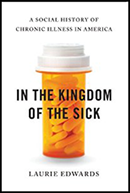
in-the-kingdomAs you know, I wrote another book.

You might not know that its release date is right around the corner: APRIL 9, 2013.

I am pretty excited to share this with you.

In the Kingdom of the Sick: A Social History of Chronic Illness In America
is available on pre-order now, and you can read more about in this starred review from Booklist.

If you’re local to the Boston area, I want to share two key author events. I would love to see you there!

1. On April 11, I will be doing a Meet the Author discussion and book signing at Northeastern University at noon. (I teach at Northeastern, so this is especially cool for me.)

2. On April 17, I will doing a reading at Brookline Booksmith at 7pm. This is one of my favorite bookstores around, and I can’t wait.

I am also really excited to announce that from late March throughout April, I am doing a virtual book tour with interviews, reviews, giveaways, and other events on different sites across the Internet, so no matter where you are, you can still be involved. I have some seriously amazing, insightful, and gracious people involved in this, and I will link to all of it from this blog.

I will also be posting events, reviews, and other press on my new Facebook page and on Twitter, so you can follow me there, too. The book explores patient rights, gender and pain, social media and patient advocacy, as well as the influence of science, technology, and culture on the experience of chronic illness (and more), and after all this time, I can’t wait to see it out in print and in readers’ hands.

Stay tuned!

Facebook Twitter Email

Rare Disease Day and Awareness

I am super excited to announce that I am now a contributor to Cognoscenti, the Ideas and Opinions page of WBUR, Boston’s NPR station. They have a great group of writers, thinkers, and innovators, and I am really grateful for the chance to contribute.

My first piece is about a cause I hold dear–rare diseases. Rare Disease Day is February 28, and in my first Cognoscenti piece I tackle what awareness really needs to be: a complement to research and innovation, not the end goal itself.

I would love if it you’d click on over, join the conversation, and leave a comment. Thanks so much, and be on the lookout for more original essays and articles soon!

Facebook Twitter Email

Important Update on #KidneyforMike

Since we first took our plea to find a living donor for my father public in October, we have continued to be amazed and humbled by the goodwill, generosity, kindness, and support we’ve received. In person, over the phone, and over social media, you have helped us spread the word, encouraged us, and given us hope.

Truly, the outpouring has been incredible—there is a long waiting list of people interested in donating a kidney to my father.

It has been a difficult few months and time has not been our side, but we are so grateful to announce that a living donor match has been found from that list, and a kidney transplant is scheduled for March 12. We cannot begin to express our gratitude to the donor and the donor’s family for this most amazing gift: a second chance at life.

It will be a long road yet, and in the coming weeks, we ask for your continued good thoughts and prayers for my father and our family, the donor and the donor’s family, and the surgical and medical teams who will be caring for both of them. Thank you so much!

Facebook Twitter Email

Pub Date: The Last Best Cure

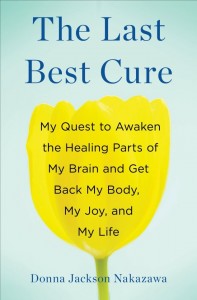
Today is the official pub date for Donna Jackson Nakazawa’s The Last Best Cure. I will have a review in coming weeks, but check out what critics are saying:

DJN cover

“The Last Best Cure will change lives; it may even save some.” –Katrina Kenison, author of The Gift of an Ordinary Day

“This is a genuine page-turning science/non-fiction thriller!” –Sylvia Boorstein, author of Happiness is An Inside Job: Practicing for a Joyful Life

“Nakazawa has written a moving account of her recovery … it will certainly inspire others.” –Andrew Weil, M.D., author of Spontaneous Happiness

And here’s a little teaser about the book itself:
One day Donna Jackson Nakazawa found herself lying on the floor to recover from climbing the stairs. That’s when it hit her. She was managing the symptoms of the autoimmune disorders that had plagued her for a decade, but she had lost her joy. For years, she’d been living on what she’d come to think of as the “Pain Channel.” She wanted to tune into the “Life Channel” instead. As a wife and mother of two, she was determined to get her life back. As a science journalist, she was compelled to understand why her brain might be her last best cure.

Donna’s writing is a must-read for anyone living with chronic illness and autoimmune disease, and The Last Best Cure is a compelling and enlightening extension of her previous work. Click on over to her site to read an excerpt.

Facebook Twitter Email

Living the Dream (Or, It Takes a Village)

Every now and then, like when it’s well past midnight and I’m setting my alarm for 4:45 so I can get some work done, or when we’re trading notes on how many loads of laundry and changes of clothes Norovirus necessitated, my husband and I will mutter “Living the dream,” and smile (smirk?) at each other.

Of course we always say it in jest, and because sometimes a little levity can make another pre-dawn computer session or raging case of toddler vomit a bit more manageable.

The thing is, though, we really are. Living the dream, that is—our particular notion of what a dream should look like, anyway, and all the lack of sleep and crazy juggling and contagious viruses and daily minutiae pale in the face of that.

I don’t like winter. The days are too dark, everyone is sicker more often, and this winter there are just too many variables to manage—teaching, side projects, book launch, merit review, household maintenance, chest PT, and of course, the really heavy stuff, like watching my father’s kidney failure progress and working on the logistics of a transplant and medically complex post-op care plans. I am tired, and I just want it to be spring.

The irony that spring represents hope and renewal is not lost on me. (But really, I’d be happy with weather warm enough for a trip to the playground, or possibly a nap.)

Anyway, as we claw our way through this snowbound February (and yes, it really is starting to stay lighter later on), I’ve taken to re-framing how I think about nineteen-hour days and the often overwhelming nature of the here and now.

Living the dream. We have a happy, healthy, joyful little girl. When she is at school, she is in a wonderful place where she is loved and where she is thriving. I get to spend so much time with her every day, a lot more time than I would in other professions, and I try not to take that for granted, ever. We go to the library and playspaces and gymnastics class, we do playgroups and playdates. We read books on the couch and hide treasures in her tent and I try to say yes to finger paints more often than not—“Just throw me in the tub right after, okay, Mama?” All the other stress and sadness and obligations of life fade away.

Part of this is because higher education is a bit more flexible schedule-wise, part of this is because I am willing to work late nights and early mornings, and a huge part of it is because I work for a wonderful institution with accommodating superiors and administrators. They support me and allow me to do what I enjoy with students I enjoy. There is room for professional growth, and innovation and initiative is rewarded with responsibility and recognition.

I have an agent and a publishing team who have been equally accommodating, and whose guidance has really helped my writing career. And lately (stay tuned) some incredible writing opportunities have come my way, things I wouldn’t have thought possible if I had sought them out myself, and all I can do is be grateful and give them my all.

My husband is almost two years into starting his own business, and while the hours are long for all of us, the benefits outweigh the (many) stresses. Seeing him get great press or expand his production facilities to meet increased demand is nice, of course. But knowing he is doing something he believes in, and something that while grueling, allows him the flexibility to come to her doctor appointments, drop her off at school, and be present in so many aspects of her daily life, is even better.

Along the way, we’ve been blessed personally and professionally with mentors and cheerleaders, those whose encouragement, advice, and enthusiasm have helped us to take risks and fight for the life we want.

Way back in the day, I wrote this post on how it takes a village when it comes to having chronic illness and raising children. And it absolutely does—when she’s sick or I’m sick or we’re both sick, we need helping hands. But unsurprisingly, my pre-child understanding of that village was a bit narrow.

The village stretches far beyond those who can help out when we’re sick, or watch our daughter so I can go to the hospital. It also includes the cheerleaders and the mentors, the bosses and the schedulers and the administrative staff, the professional colleagues who go out of their way, the doctors, nurse practitioners, and nurses who manage our conditions, my physical therapists, the daycare staff, and so many more. It’s the family and friends who are a constant, and those who understand when life gets complicated and we fall off the radar.

If I’ve learned anything in the months since we started looking for a living donor for my father and we’ve witnessed the amazing outpouring of support and sacrifice, it’s that the web of people who care is intricately linked and stretched out beyond our immediate circle, and beyond the circle beyond that circle, even.

I won’t deny this is a hard season we’re in, in every sense of the term. As is always the way, it seems like there are so many exciting things going on right when so many tough things are. I know things will get easier soon, when the book is launched and I’m feeling better and the work winds down a bit. I also know that things could get much harder before they begin to get easier. I can’t wait for spring, but the enormity of what could happen between now and then is hard to translate.

For now, I am keenly aware of all the scaffolding that exists that supports us and enables us to live this dream, in all its imperfections.

Facebook Twitter Email

Chronic Illness, Pain and Gender, and Brain-Body Science

I’m talking about why we’ve been slow to address the needs of those with chronic illness and utilize brain-body science over at Donna Jackson Nakazawa’s blog today. I’ve mentioned before what a big fan of her writing I am, particularly The Autoimmune Epidemic, and am so excited for her forthcoming book, The Last Best Cure. (I’ll review it here soon…)

Anyway, I’d love it if you click on over and join the discussion.


Facebook Twitter Email

Cardiovascular Disease in Younger Women: Michelle’s Story

February is American Heart Month. Cardiovascular disease is the leading cause of death in the United States, and heart attack and stroke are responsible for one in three deaths, or 2,200 deaths per day, according to the CDC. Heart attack and stroke are all too familiar in my family. But this fall, stroke touched another important person in my life, my dear friend Michelle. She is a lifelong competitive athlete, and as an extremely physically fit, health-conscious young woman who was already an advocate for awareness of heart disease, she is the absolute antithesis of what you would think of as a cardiovascular patient.

And that’s the point. At thirty-two and in wonderful health, she had a stroke.

As her friend and former roommate, I have always admired Michelle’s tenacity and drive—from running marathons and competitive cycling to building her career and maintaining friendships, she does everything with gusto. She has responded to having a stroke with grace and that same tenacity, and I am so proud of her continued efforts to advocate and raise awareness about cardiovascular disease in women. Please read her story below, in her own words, and learn the signs and symptoms of stroke and heart attack.

*     *     *

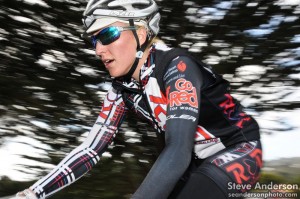
MichellebikeI’d like to say a special thank you to Laurie for inviting me to take part in her wonderful blog. I believe the work she is doing is so meaningful for everyone. We will all experience illness at some point in our lives. Many of us may just get the flu but often we all struggle silently with illness like pain or diabetes. I appreciate the opportunity to share my story.

I was always the “healthy” one. I’d been an athlete for as long as I could remember. I teased my family that I was going to be an athlete because they used to take me cross country skiing in the Sierra Nevada Mountains in California for hours during the winter as fun. High altitude training at the age of 7!

As a junior national athlete in rowing, I went on to row in college and later picked up running marathons for 8 years. In 2010 I found my way to competitive bike racing via triathlon. The training and female competitive spirit in bike racing appealed to me. Yet, I wondered if we could do something more then just ride bicycles. What if we could give back to the community for a cause while training and racing?

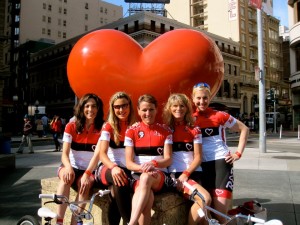
The cause for my race team, RED Racing, was inspired by the death of my father, who passed away from a heart attack in 2006. It turned out that many women on my team had their own families impacted by heart disease and stroke. While my cause was around heart health and my dad, I soon learned that heart disease and stroke is the #1 killer of women in the U.S. Today, RED Racing is a group of female cyclists committed to developing competitive racers while building awareness and supporting the American Heart Association.

Ironically, on Oct 13, 2012 I found out that this disease can affect anyone, including me.

I was riding my bike that Saturday morning with a friend. We were about 35 miles out and headed home when my vision suddenly changed. I got off my bike ASAP and thought maybe I needed to eat something so I wolfed down my shot blocks but things didn’t change. The world looked sideways. I discovered that by shutting one eye everything was fine. Closing the other eye again, everything was fine. But with both eyes open I had double vision.

I was definitely worried and couldn’t imagine what was happening. I thought, “I’ll just close my eyes and take a deep breath and this will all go away. I can handle this. I can control this.”

My friend helped me walk to a driveway to sit down and call for help. While seated I kept falling towards the right and wasn’t able to see clearly. A woman (a mom) pulled out of her driveway and stopped to check on us asking if we were okay. For the first time in my life, I actually said “no,” and asked her to  drive us to urgent care. She ended up driving us all the way back to Baltimore and to Johns Hopkins. She and my friend are my guardian angels! They really saved me that Saturday by knowing to call for help and getting me to the hospital as fast as possible.

I couldn’t make my eyesight go back to normal and in the car to the hospital things got a little worse. My speech was slurred and I threw up (although that made me feel better.) By the time we go to the hospital about an hour had passed. I had a team of 10-12 people assessing me and got to a CAT scan very fast, where the brain scans showed that I had a tiny stoke but no major damage. All tests show that I’m perfectly healthy and they don’t know why this happened. The one thing to point to is birth control.

Honestly, I’m still a little anxious by all of it. I really never thought this could happen to me. Even when I was having symptoms I didn’t think it was a stroke. I thought maybe I was tired or didn’t eat enough. This was a terrifying experience. I’m so lucky to see. I’m so lucky to be able to get back on my bike. I’m so lucky to be alive.

I’m grateful! So grateful.

Now, about 3 months later, I feel great. My vision is fine but I’m still going through some blood tests as the doctors are trying to understand why this happened. I’m off birth control and take a small 81mg aspirin daily. Now, I have a chronic illness. I have an acute understanding about how fragile life is and how quickly things can change. I’m not the only 32-year-old who has had a stroke and many of the stories I’ve heard are devastating. Paralysis, blindness, and death could have been my reality. Now I consider everything I eat. I worry about what pregnancy could bring and I live my life with an illness that is silent. Another stroke could be in my future and there aren’t many warning signs for me to show if I’m at risk. The best thing I can do is to eat leafy greens and live the best life I can.

RED Racing
big heartWe are a group of female cyclists committed to developing competitive racers while building awareness and supporting the American Heart Association. Our combined mission will be to dispel the myths and raise awareness of heart disease as the number one killer of women. We hope bike riding can be another means to empower women to take charge of their heart health, to feel young again, and to be inspired to live a healthy lifestyle. RED Racing is the avenue for us to raise awareness and support the AHA in its fundraising and awareness goals. (Editor’s note: you can check out the RED Racing fundraising page by clicking here.)

*     *     *
Thank you for sharing your story, Michelle. I am so grateful you are doing so well.

Facebook Twitter Email